
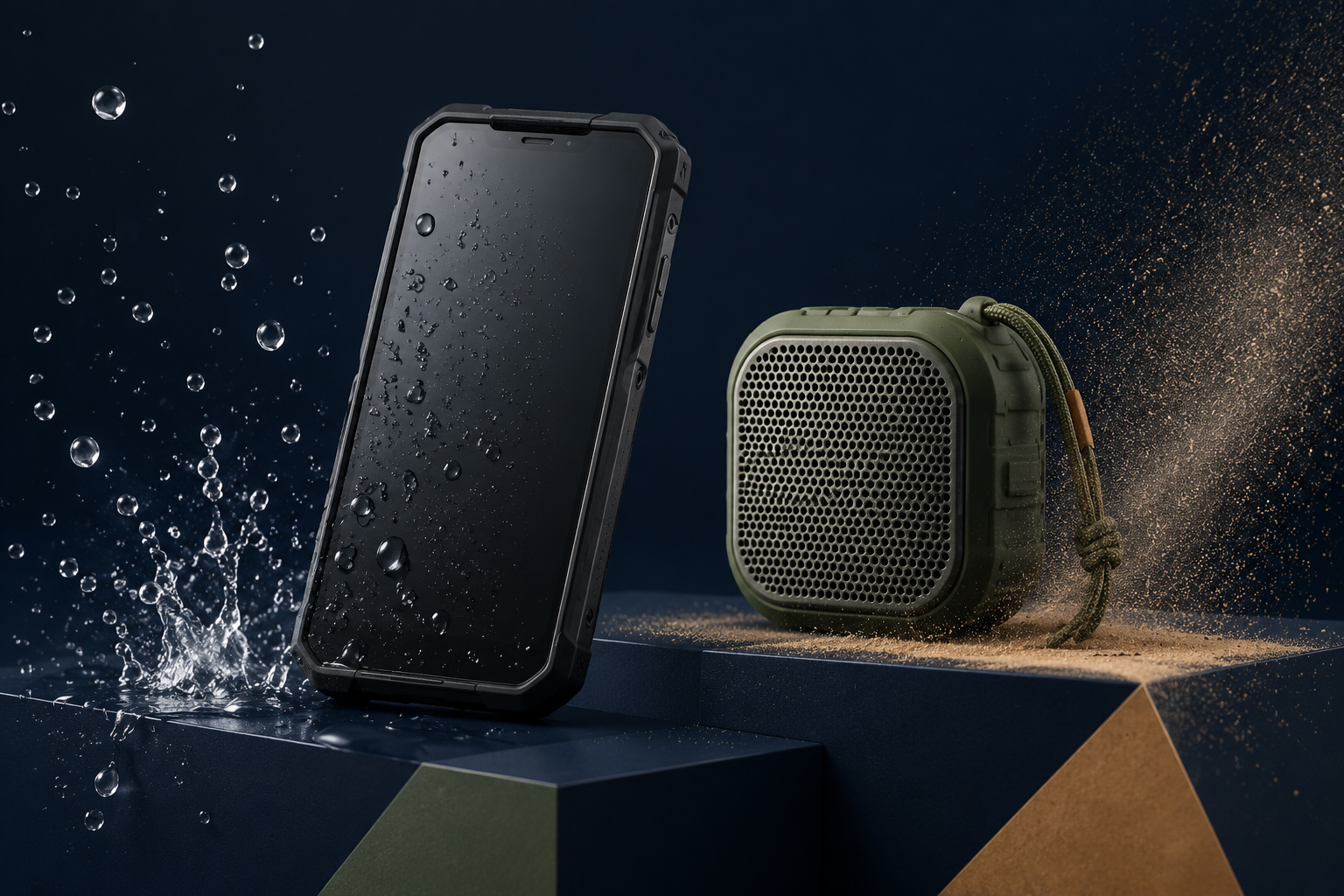
An IP rating describes tested protection against solid objects and water entering an enclosure. The two characters matter separately, and the rating does not make a product permanently waterproof.
Last reviewed: August 29, 2026. Always confirm the manufacturer’s exact test conditions and care instructions for the model you are considering.
IP stands for ingress protection. In a rating such as IP67, the first digit describes protection against solid objects and dust; the second describes protection against water. IP67 means dust-tight protection at the highest solids level and protection under a defined temporary-immersion test. It does not mean a device can be used indefinitely underwater, in every liquid or after seals have worn.
Read both positions
A strong dust rating does not imply the same level of water protection, or vice versa.
“X” means not rated
IPX7 reports a water test but does not claim a tested solids level in that position.
Conditions are specific
Depth, duration, pressure, orientation and water type can all matter.
Ratings are not permanent
Wear, repairs, drops, heat, detergents and damaged seals can reduce protection.
IP ratings give buyers a compact way to compare how an enclosure resists dust, fingers, tools and water. They appear on phones, speakers, cameras, lights, plugs, switches, watches and industrial equipment. The code is useful only when you translate both positions and match the stated test to the exposure the product will actually face.
This is why an IP rating belongs in a wider specification check rather than acting as a quality score. Start with the specifications that matter for your use, then use our practical guide to what an IP rating tells you when comparing particular products.
What does an IP rating mean?
IP stands for ingress protection. The rating system is defined by IEC 60529, an international standard for classifying the protection provided by electrical enclosures. The International Electrotechnical Commission’s IP ratings overview explains that the first numeral relates to solid foreign objects and the second relates to water.
An enclosure is the physical barrier around the parts being protected. On a phone, that may include the frame, screen, buttons, ports, trays, adhesives and seals. On an outdoor light, it includes the housing, lens, cable entry and joints. The rating describes the tested enclosure configuration, not a promise about every possible way the product can be used.
How to read the first digit: solids and dust
The first digit runs from 0 to 6. Lower levels deal with larger objects and accidental contact; the highest levels address dust. The wording is more precise than “dust-resistant”, so pay attention to the difference between limited dust ingress and dust-tight protection.
| First digit | General meaning | Practical interpretation |
|---|---|---|
| 0 | No rated protection | No claimed solids protection under the code. |
| 1 | Objects 50 mm and larger | Protection against large body surfaces, not deliberate access. |
| 2 | Objects 12.5 mm and larger | Commonly associated with finger-sized access. |
| 3 | Objects 2.5 mm and larger | Protection against certain tools or thick wires. |
| 4 | Objects 1 mm and larger | Protection against most wires and small solid objects above the test size. |
| 5 | Dust-protected | Some dust may enter, but not enough to interfere with satisfactory operation or safety. |
| 6 | Dust-tight | The highest listed solids level: no ingress of dust under the specified test. |
A first digit of 6 can be valuable for a workshop, beach, trail or dusty site, but it does not tell you whether the product survives a drop or resists water. Those are separate questions. When two products have different codes, compare them with the same method you would use for any product specification: translate the number into a real task, then ignore differences that do not affect that task.

How to read the second digit: water
The second digit describes tested resistance to water. It is easy to assume that every larger number includes every lower test. That is not always safe. The immersion tests at levels 7 and 8 are different from the water-jet tests at levels 5 and 6, so a manufacturer may need to state more than one rating when both exposures matter.
| Second digit | General water test | What to remember |
|---|---|---|
| 0 | No rated protection | No water-protection claim under the code. |
| 1 | Vertically falling drops | A limited dripping-water test in a defined position. |
| 2 | Falling drops with enclosure tilted | Tests dripping water at specified tilt positions. |
| 3 | Spraying water | Protection from spray within defined angles. |
| 4 | Splashing water | Protection against splashes from any direction under the test. |
| 5 | Water jets | Protection against a specified low-pressure jet. |
| 6 | Powerful water jets | A more demanding jet test; not a licence to pressure-wash the product. |
| 7 | Temporary immersion | Protection under defined depth and time conditions, commonly up to 1 metre for 30 minutes. |
| 8 | Continuous immersion | Conditions are agreed or stated by the manufacturer and are more severe than level 7. |
| 9 | High-pressure, high-temperature water jets | A specialised demanding wash-down test found on suitable equipment. |
Check the documentation rather than relying on the numeral alone. The IEC’s guide to ingress protection ratings provides the standards context, while a product manual should name the depth, duration, temperature, orientation and any required covers or port closures.
What common IP ratings tell you
| Rating | Plain-English starting point | Do not assume |
|---|---|---|
| IP44 | Protected from objects 1 mm and larger and splashing water | Dust-tightness or immersion protection |
| IP54 | Dust-protected and protected from splashing water | Full dust exclusion or water jets |
| IP65 | Dust-tight and protected against specified water jets | Immersion protection |
| IP66 | Dust-tight and protected against powerful water jets | Safe use under water |
| IP67 | Dust-tight and protected during defined temporary immersion | Permanent underwater use or jet protection unless separately stated |
| IP68 | Dust-tight and tested for immersion under manufacturer-stated conditions beyond level 7 | Unlimited depth, time or every type of liquid |
| IPX7 | No stated solids level in this code; protected during defined temporary immersion | Dust protection or water-jet resistance |
IP67 versus IP68 is not simply “good” versus “better”. IP68 may provide a more demanding immersion claim, but the conditions can differ between products. If you need rain, spray, a poolside device or underwater equipment, match the specific exposure instead of buying the highest number you see.
What does the X mean in IPX7 or IP6X?
An X means that position does not state a protection level. IPX7 tells you about a water test at level 7 but gives no solids numeral. IP6X tells you the enclosure is rated dust-tight but does not state a water numeral. It does not necessarily mean the product has zero protection in the X position; it means you do not have a rated level there from that code.
JBL’s official explanation of IPX7, for example, describes temporary immersion up to one metre for 30 minutes while noting that dust resistance has not been tested. The exact product instructions still control how ports, caps and drying should be handled.
Does IP67 or IP68 mean waterproof?
“Waterproof” sounds absolute; IP tests are conditional. Fresh water in a laboratory is different from salt water, chlorinated pools, soap, drinks, steam or a high-pressure jet. Depth increases pressure. Movement, impact and temperature changes can affect seals. A rating achieved when new may not describe a device after a drop, battery replacement, screen repair or years of wear.
Liquid damage may also be treated differently under a written warranty. Before paying more for a high rating, read the product warranty and check whether the stated use, exclusions and remedy match your risk. An impressive code with broad liquid-damage exclusions may still be useful, but it should not be mistaken for insurance.
How to use IP ratings when buying
- Name the exposure. Dusty workshop, rain, hand washing, splashes, water jets and immersion are different jobs.
- Translate both characters. Do not treat the combined number as a score out of 99.
- Read the manufacturer’s conditions. Look for depth, duration, required port covers, water type and care instructions.
- Check other forms of durability. An IP rating does not cover drops, crushing, vibration, temperature, corrosion or screen scratches.
- Read warranty exclusions. Find out whether liquid damage is covered and whether a repair changes the rating.
- Compare like with like. Use the same exposure and evidence for every candidate.
Save the manual or specifications page as part of your product research. If two products use different marketing language, put their precise ratings, test conditions, repair policy and price into a fair comparison.
Phone or watch
Consider sweat, rain, immersion conditions, charging ports, repairs and liquid-damage exclusions.
Portable speaker
Match splashes or immersion, then check whether sand and dust are also rated.
Outdoor light
Consider rain direction, dust, cable entries, mounting orientation and installation instructions.
Workshop equipment
Check dust size, water jets, temperature, impact and any industry-specific requirements.
How to preserve dust and water resistance
Keep seals, trays and covers clean and properly seated. Do not insert objects into wet ports or use compressed air unless the manufacturer says it is safe. Rinse salt, sand or chlorinated water only according to the manual, dry the product as directed and wait before charging. Cases and screen protectors can help with impact, but they do not automatically increase the device’s IP rating.
Ask about resistance after a repair. Replacing a screen, battery or housing can disturb seals; a competent service provider should explain whether it restores and tests the enclosure. When buying refurbished, use the refurbished-product checklist and ask specifically about liquid history, seals, replacement parts and any post-repair ingress test.
Frequently asked questions
Is IP68 better than IP67?
For immersion, IP68 is tested under manufacturer-stated conditions beyond level 7. That can be more demanding, but the exact depth and duration vary. Compare the stated conditions and your use rather than assuming every IP68 product is equivalent.
Can I swim with an IP68 phone?
Not from the code alone. Swimming adds movement, depth changes and possibly salt or chlorine. Check the manufacturer’s explicit swimming guidance, warranty and care instructions.
What does IPX7 mean?
It states temporary-immersion protection at water level 7 but does not state a tested solids level in the first position. It does not automatically prove resistance to water jets.
Does IP65 protect against rain?
IP65 includes dust-tight protection and a specified water-jet test, but installation, orientation and cable entries still matter. Follow the product’s outdoor-use and mounting instructions.
Is a higher IP number always better?
No. The positions represent different tests, and the best rating is the one that matches the exposure. Paying for immersion protection may add little value to a dry indoor product, while impact or temperature resistance may matter more.
Can an IP rating wear out?
The rating belongs to the tested enclosure design, but real-world protection can decline with damaged seals, drops, repairs, contamination and age. Treat resistance as a feature to maintain, not a permanent guarantee.
Does an IP rating cover salt water or drinks?
Not unless the manufacturer explicitly says so. Standard claims commonly refer to fresh water under controlled conditions; salt, chlorine, soap, coffee and other liquids can behave differently and cause corrosion or residue.
Read an IP code one position at a time: solids first, water second. Match the test to the dust, splashes, jets or immersion you expect; check the manufacturer’s exact conditions; and remember that drops, repairs, wear and non-fresh liquids sit outside the simple two-digit promise.