
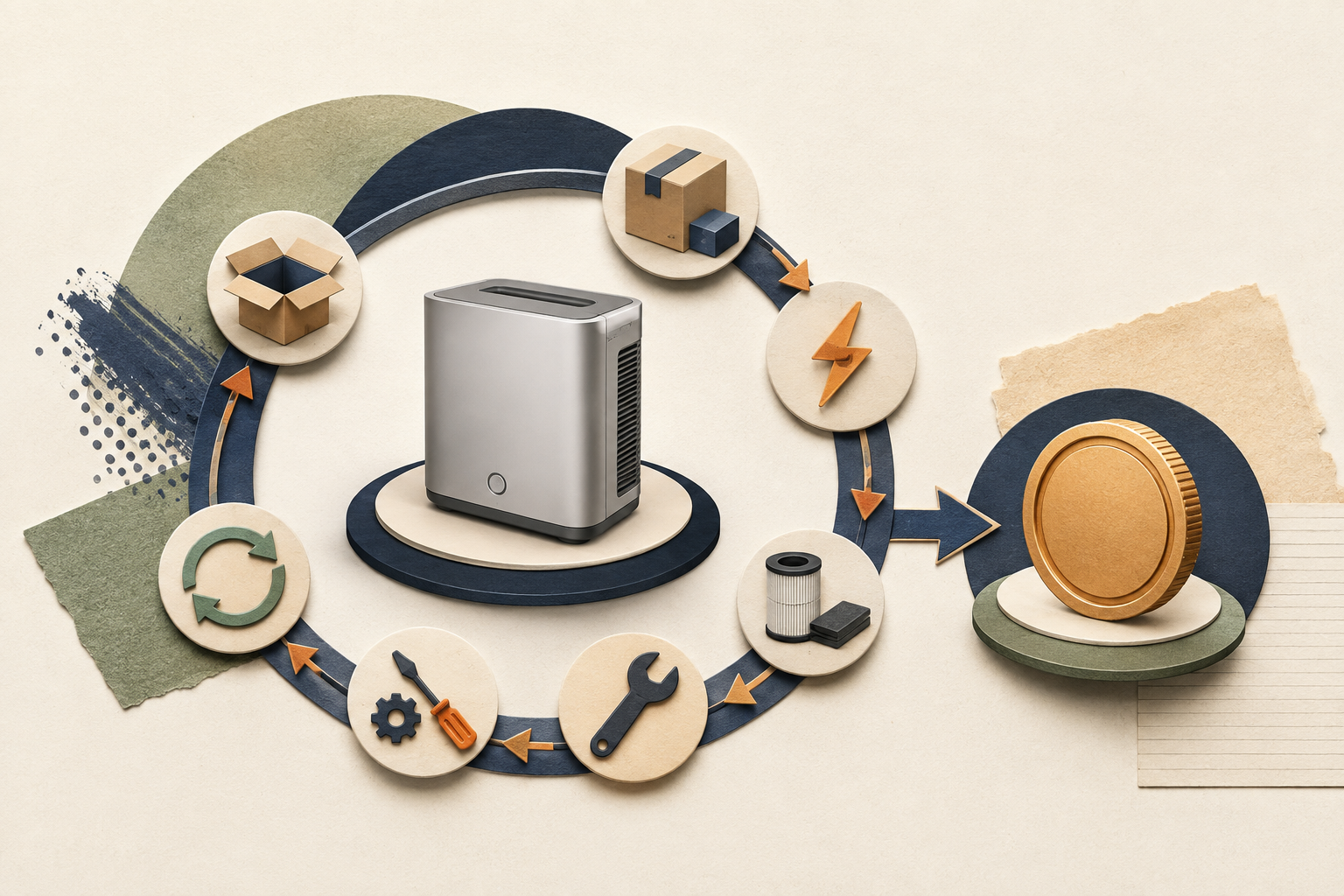
The price on a product page is only the beginning of the financial decision. Total cost of ownership helps you look at what a product may cost to buy, set up, use, maintain and eventually replace.
Last reviewed: August 22, 2026. Prices, energy costs, subscriptions and product terms can change, so check current information before buying.
Total Cost of Ownership, or TCO, is the full cost of owning a product over a chosen period. It can include the purchase price, delivery and setup, energy or fuel, subscriptions, consumables, maintenance, repairs, upgrades and disposal. If the product still has realistic resale or trade-in value, that value reduces the net cost.
Purchase price
What you pay to obtain the product at the start.
Running costs
What you spend to use it, such as energy, fuel, data or consumables.
Ownership costs
Maintenance, repairs, accessories, upgrades and other costs over time.
End value
Resale or trade-in value can reduce the cost you ultimately carry.
What does total cost of ownership mean?
Total Cost of Ownership is a way to estimate what a product will cost across the time you expect to own it. The purchase price is part of the calculation, but it is not the whole calculation.
For example, a printer may look inexpensive until you consider ink and paper. An appliance may have a higher price but use less energy or need fewer replacement parts. A phone may come with a low upfront price but require a subscription, accessories or an earlier upgrade.
TCO gives these costs one wider view. It helps you compare the financial reality of ownership rather than comparing only the number shown beside the Buy button.
What costs are included in TCO?
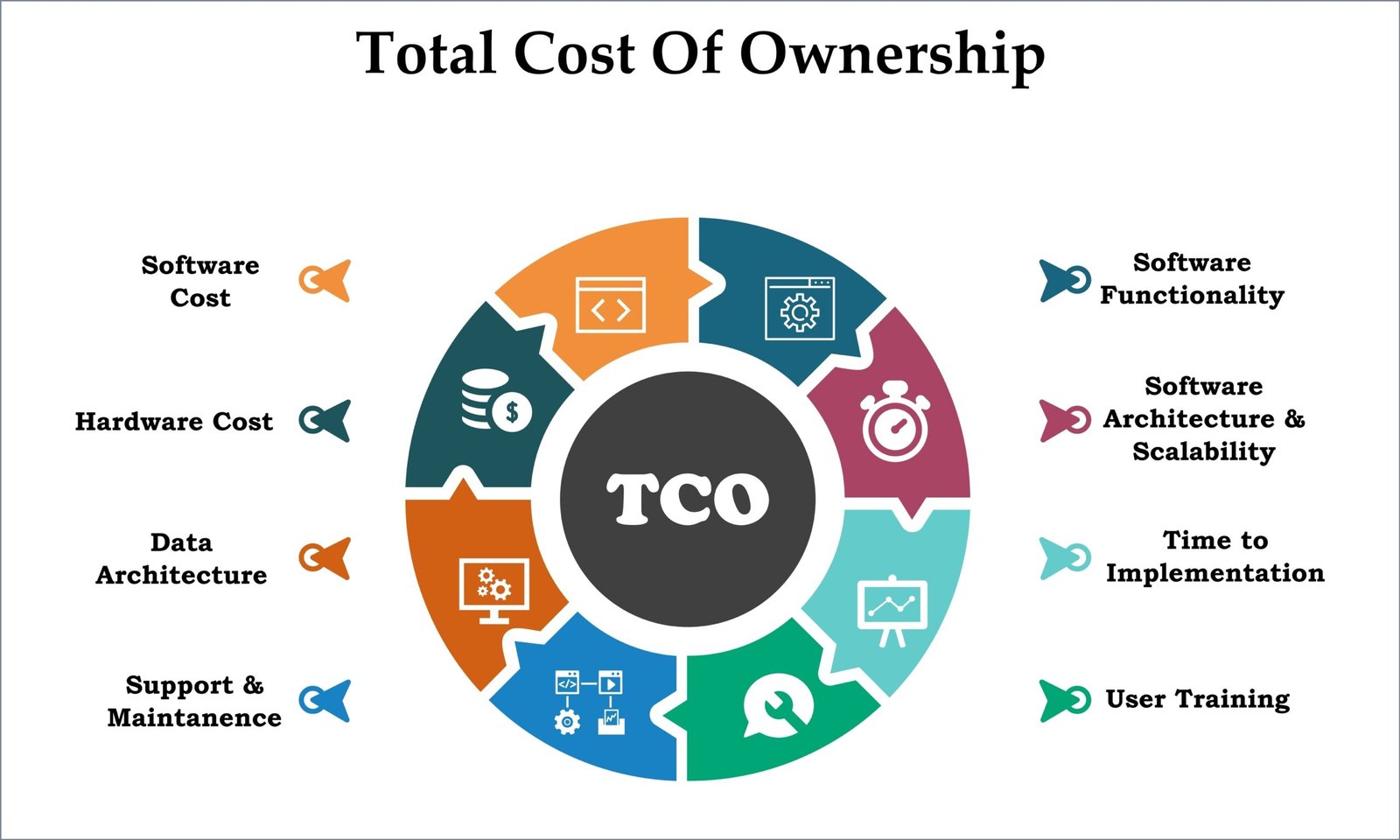
There is no single list that fits every product. A useful TCO estimate includes the costs that are likely to differ between the options you are considering.
| Cost area | What it may include | Common examples |
|---|---|---|
| Initial cost | The amount needed to obtain the product. | Product price, delivery, taxes or installation. |
| Setup cost | What is needed before the product can do its job. | Adapters, accessories, assembly or software setup. |
| Operating cost | The cost of using the product over time. | Electricity, fuel, data plans, subscriptions or consumables. |
| Maintenance cost | Routine work that keeps the product usable. | Filters, cleaning supplies, servicing or replacement batteries. |
| Repair cost | Unexpected work when something fails or wears out. | Parts, labour, shipping or paid technical support. |
| Upgrade cost | Later spending that extends or improves use. | Extra storage, new accessories, software or a larger power supply. |
| End-of-life cost | What happens when you stop using the product. | Disposal, recycling, removal or replacement. |
| Resale value | Money recovered when the product is sold or traded in. | A realistic second-hand price or trade-in credit. |
Why is the purchase price not the full cost?
The purchase price is easy to see and easy to compare. That makes it useful, but also easy to overvalue.
Some products create small costs repeatedly. Others create larger costs only occasionally. A low-priced device that needs paid accessories, a recurring service or an early replacement may not be the cheaper choice over several years.
The opposite can also be true. A higher-priced product is not automatically better value. If its extra features do not solve a problem you actually have, the additional price may simply increase your TCO.
The point of TCO is not to make every purchase look more complicated. It is to reveal the costs that could materially change the decision.
Simple examples of total cost of ownership
The following examples show how the idea works without pretending that one exact number applies to every household.
A printer
Its TCO may include the printer, delivery, ink or toner, paper, maintenance, replacement parts and the cost of replacing it. A cheaper printer is not necessarily cheaper if its consumables are expensive for your usage.
An appliance
Its TCO may include delivery, installation, electricity, filters, cleaning supplies, servicing and repairs. The expected life and likely repairability also affect the comparison.
A phone or software plan
Its TCO may include the device, case, charger, cloud storage, app or service subscriptions, repairs, upgrades and the resale value of the old device.
A refurbished product
Its TCO may include the lower purchase price, any missing accessories, a shorter warranty, possible battery replacement and its expected resale value. Condition and support are part of the risk picture.
These examples are reminders to ask what the product needs in order to remain useful. They are not reasons to add every possible expense to every comparison.
Can an expensive product have a lower TCO?
Yes. A higher upfront price can produce a lower TCO when it meaningfully reduces another ownership cost.
That might happen if the more expensive option:
- Uses less energy during your normal usage;
- Needs fewer consumables or less frequent replacements;
- Includes accessories you would otherwise buy separately;
- Has a longer useful life for your situation;
- Is easier to repair or has better parts availability;
- Retains more realistic resale or trade-in value.
But the extra price only creates value if the difference matters to you. Paying more for a feature you will never use does not improve your personal TCO.
Why does the time period matter?
TCO depends on how long you expect to own the product. A product with low running costs may look less attractive over one year and more attractive over five years. A product with a high repair risk may appear reasonable for a short period but less appealing if you expect to keep it much longer.
Choose a period that matches the decision. You might use:
- One year for a short-term device, subscription or temporary need;
- Three years for many electronics and everyday products;
- Five years or the expected useful life for an appliance or durable item.
Use the same period for every product in a comparison. If one option is calculated over three years and another over five, the results are not directly comparable.
What is the TCO formula?
A simple consumer version of the formula is:
You do not need to estimate every category for every purchase. If a cost does not apply, leave it out. If it is the same for every option, it may not help you distinguish between the options.
For a practical worksheet that turns this formula into a product comparison, see How to Calculate the Real Cost of Owning a Product. That guide focuses on doing the calculation. This article focuses on understanding what the calculation means.
TCO vs purchase price vs cost per use
These measures answer different questions. Mixing them together can make a comparison less clear.
| Measure | Main question | What it is useful for |
|---|---|---|
| Purchase price | What do I pay at the start? | Checking the immediate budget and upfront affordability. |
| Total Cost of Ownership | What may this product cost over the ownership period? | Comparing the wider financial impact of different products. |
| Cost per use | What does each use or unit of output cost? | Comparing value when usage frequency can be estimated. |
Cost per use can be useful for products such as printers, coffee machines or tools. It is still based on assumptions about how often you will use the product, so it should support the TCO view rather than replace it.
How should you use TCO when comparing products?
Use TCO as one decision lens. It should make important trade-offs visible, not turn a normal purchase into an accounting exercise.
- Choose the ownership period. Use the same period for every product.
- Estimate your normal usage. Energy, fuel, consumables and subscriptions depend on how you will actually use the product.
- List the costs that differ. Focus on the costs that could change the ranking between products.
- Separate known costs from estimates. Mark the figures you know, the figures based on current prices and the figures that are uncertain.
- Use realistic resale value. Do not assume the highest advertised second-hand price will be available to you.
- Check what the extra cost solves. A lower TCO matters only if the product still meets your needs.
- Consider non-financial ownership factors. Warranty support, repair access, downtime and ease of use may affect the best choice even when the totals are close.
When you are ready to compare actual products, start with How to Research a Product Before Buying and How to Compare Products Online. For energy-related products, What Does Energy Efficiency Actually Mean? and What Is Standby Power? can help you interpret running costs more carefully.
What are the limits of TCO?
TCO is useful, but it is still an estimate of a future period. The result can change when prices, usage, product life, repair needs or resale conditions change.
There are also costs that do not fit neatly into a financial total. A product that is difficult to set up, frequently unavailable or frustrating to maintain may be a poor fit even if its estimated TCO is low. A product with better support may be worth more to you even when the price difference is not fully captured in the formula.
That is why TCO should be read alongside the product’s warranty, repair options, compatibility and normal usefulness. You can learn more about warranty terms in How to Read a Product Warranty and about the later repair decision in How to Decide Whether to Repair or Replace Something.
The bottom line
Total Cost of Ownership means looking beyond the purchase price to the wider cost of using and keeping a product. Depending on the product, that may include setup, energy, subscriptions, consumables, maintenance, repairs, upgrades and end-of-life costs, less any realistic resale value.
The most useful question is not “Which product is cheapest?” It is “Which product gives me the right result at an acceptable total cost over the period I expect to own it?”
Use TCO to reveal important costs, not to predict the future perfectly. Compare the same ownership period, use realistic assumptions and make sure the lower-cost option still solves the problem you are buying it to solve.
Frequently asked questions
What is Total Cost of Ownership in simple terms?
It is the full estimated cost of buying, using, maintaining and eventually replacing or disposing of a product over a chosen period.
Is Total Cost of Ownership the same as the purchase price?
No. The purchase price is the upfront amount. TCO also considers costs that arise during ownership, such as energy, subscriptions, consumables, maintenance and repairs.
What costs are usually included in TCO?
Common categories include the purchase price, delivery and setup, operating costs, recurring fees, maintenance, repairs, upgrades, disposal and realistic resale value.
Can a more expensive product have a lower TCO?
Yes. A higher-priced product may have lower operating, maintenance or replacement costs. The extra price is worthwhile only when that difference matters for your usage.
Does TCO include maintenance and repairs?
It can. Routine maintenance and likely repair costs are important parts of the ownership picture, especially for products that need servicing, filters, batteries or replacement parts.
Should resale value be included in TCO?
Yes, when resale or trade-in value is realistic and relevant to the comparison. Subtract a conservative estimate rather than assuming the best possible second-hand price.
How long should I use for a TCO calculation?
Use a period that matches how long you expect to own the product, such as one, three or five years. Use the same period for every product you compare.
Is TCO useful for ordinary household products?
Yes. It can be useful for appliances, electronics, printers, tools, vehicles, subscriptions and any product with meaningful running or maintenance costs.
What is the difference between TCO and cost per use?
TCO estimates the total cost over an ownership period. Cost per use divides a cost by the number of uses or units of output, so it depends more heavily on how often you use the product.
Can TCO be calculated exactly?
Usually not. Future energy prices, repairs, product life and resale value are uncertain. A transparent estimate with sensible assumptions is more useful than false precision.