
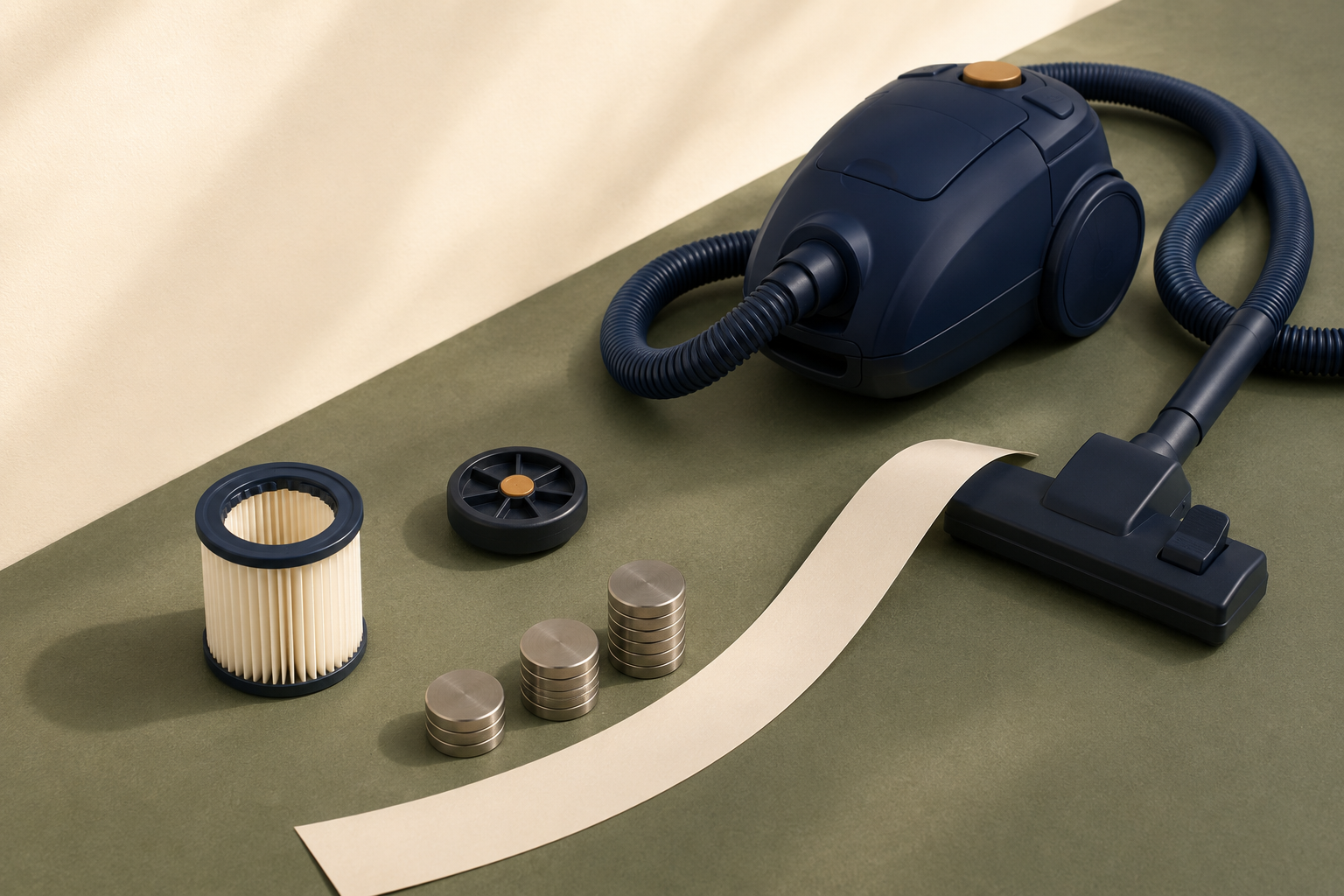
Cheap products can cost more once you add replacements, refills, electricity and repairs. Here is how to spot a false economy—and when a basic, inexpensive option really is good value. The useful question is whether extra costs are likely in your situation, not whether the product is cheap.
Last reviewed: September 2, 2026.
The cheapest option becomes a false economy when its extra ownership costs exceed the money saved upfront. Compare the same job over the same period, check the largest recurring costs, and test uncertain lifespan assumptions. A basic, reliable product can still be the best-value choice.
A low price is a real benefit. It leaves money available for other needs and can make an essential purchase possible. The problem starts when we treat that first payment as the whole bill.
A vacuum with costly filters, clothing that needs frequent replacement, or a device that cannot do the job without a subscription may cost more than the shelf label suggests. Looking at total cost of ownership helps you compare the complete purchase without assuming that a higher price guarantees better quality.
Why cheap products cost more: six possible causes
None of these costs is inevitable. Treat them as questions to investigate, not reasons to reject every budget product.
1. You buy the same thing again sooner
A cheaper item can become expensive if it needs replacing several times while a suitable alternative remains useful. The comparison must include every replacement needed during your chosen period, not just the first purchase.
Look at the parts most likely to end the product’s useful life: a zip, hinge, battery, wheel, connector or switch. An otherwise sound product offers poor long-term value if a small worn part cannot be replaced. However, a high price alone tells you neither when that part will fail nor whether a repair will be practical.
2. Consumables make the initial saving disappear
Filters, bags, blades, cartridges, cleaning fluid and replacement heads can matter more than the original equipment price. Find the exact refill model, its current price and the manufacturer’s replacement guidance before buying the main product.
Check quantities as well as prices. A less expensive pack may contain fewer usable refills. For printers, compare stated yields under comparable testing conditions and remember that your printing habits can change actual results. Included starter supplies may also differ between models.
3. Running costs are higher
For an appliance used regularly, a modest electricity difference can accumulate. Compare models with the capacity and function you need; do not assume that a larger, higher-star appliance will use less energy in total than a smaller one.
The official Energy Rating Label guide explains that annual consumption figures come from standardised tests, while actual use may differ. Use the labelled kWh figure with your electricity rate as an estimate, and read our explanation of what energy efficiency actually means before comparing stars alone.
4. A small fault requires an expensive response
Parts availability, labour, transport and diagnosis can determine whether a repair makes sense. Ask for the price of an ordinary wear part, not just a promise that the product is “serviceable.” Find out whether a local repairer can obtain it and whether you must send the whole item away.
Before paying for a replacement, use a repair-or-replace decision process. Also check your rights. In New Zealand, the Consumer Guarantees Act can provide remedies for qualifying faulty goods bought from a business. A warranty’s expiry does not automatically end those rights. Do not budget a cost as unavoidable when the seller may be responsible for putting the problem right.
5. The product is cheap but wrong for the job
Buying too little capacity or the wrong fit can lead to buying twice even when nothing breaks. A chair you cannot sit in comfortably or a tool that cannot handle your regular task has not become good value merely because it still works.
With clothing, try the movement you will actually make, inspect closures and read care instructions. A garment that needs costly cleaning may be less economical for your routine than a slightly dearer washable alternative. The right comparison includes fit, use and care—not just fabric labels or brand names.

6. Extras and inconvenience were left out
A missing cable, paid installation, delivery charge or required subscription can change the real starting price. Look at the complete working setup. An accessory you already own should not be charged to both options, while an accessory needed only for one option belongs in that column.
Repeated shopping, returns and time without an essential item also matter. Record those burdens separately from cash unless they create an actual expense. Calling every hour of inconvenience a large financial loss can make almost any premium look attractive.
Compare the same job over the same period
Choose a realistic ownership period before looking at totals. “Six years of weekly cleaning” is more useful than comparing the full lifetime of one vacuum with only the first year of another. Then match the required performance, capacity, accessories and condition.
Only include costs that belong to the comparison. Common costs can be left out if you clearly say so. If both options need the same detergent, it will not change which wins. If one needs an expensive proprietary detergent, it may change the result substantially.
Count a repair or a replacement consistently. Do not charge for a major repair and then also assume the same fault immediately forces a full replacement. If resale is uncertain or immaterial, use zero rather than an optimistic guess. The step-by-step guide to calculating the real cost of owning a product can help organise a larger purchase.
A cheaper vacuum that costs more—and the assumption that reverses it
Consider two hypothetical vacuums that both do the required job. These are invented numbers to demonstrate the method, not product recommendations, market prices or lifespan predictions. The comparison covers six years, with no resale value and the same electricity use.
| Cost over six years | Budget option A | Option B |
|---|---|---|
| Price of each unit | $120 | $240 |
| Assumed usable life per unit | 2 years | 6 years |
| Units needed | 3 | 1 |
| All purchases | $360 | $240 |
| Filters and other consumables | $90 | $120 |
| Paid repair allowance | $0 | $50 |
| Electricity | $36 | $36 |
| Total | $486 | $446 |
Option A saves $120 at the first checkout, but costs $40 more over six years under these assumptions. Option B is not cheaper to run: its advantage comes entirely from avoiding two replacement purchases. Delivery, disposal and financing are assumed to add nothing here; include them if they differ in your real comparison.
Now let option A last three years instead of two. You need only two units, so its total falls to $366. It becomes $80 cheaper than option B. Alternatively, if B’s repair bill is $120 rather than the assumed $50, its original total rises to $516, making A cheaper in the two-year-life scenario.
Frequency also changes value. At 100 cleaning sessions per year, the original totals work out to 81 cents and about 74 cents per session. Our cost-per-use explanation shows how to use this measure without inflating the number of times you will use something.
What evidence deserves weight?
Start with details you can check. A replacement-filter listing is stronger evidence than “low maintenance.” A written support commitment is stronger than “future-proof.” A useful long-term review describes use, age and faults, rather than repeating the launch specifications.
| Question | Useful evidence | What it cannot prove |
|---|---|---|
| Will it last? | Construction, common failure points, long-term testing and owner reports | The exact lifespan of your individual item |
| Can it be maintained? | Care instructions, replacement part numbers and current supply | That a part will always remain available |
| What will it cost to run? | Comparable test data, refill prices and your likely usage | Your future energy tariff or consumption |
| Who helps if it fails? | Seller identity, written warranty and repair arrangements | That a claim will involve no delay or effort |
Keep the quality question separate from the price question. As our guide to cheap versus expensive products explains, a higher price can pay for features, finish or positioning rather than durability. Ask what specific improvement reduces a cost or solves your problem.
Maintenance matters too. Consumer Protection’s product-life guidance points to use and care as important factors. Follow the product’s own instructions; neglect can shorten the life of both a budget purchase and an expensive one.
When the cheapest option is genuinely sensible
It meets the need without extra costs
A simple design, standard supplies and adequate performance can be excellent value. Unused premium functions do not create savings.
You need it infrequently
A durability premium may never pay back when the product gets little wear. Consider borrowing or hiring for a one-off task.
The role will change soon
A temporary setup or changing size requirement can make a long-life premium less useful. Buy for a realistic period, not an imagined lifetime.
The more expensive alternative lacks evidence
If repair options, running costs and useful quality are similar, keeping the upfront saving may be the sounder decision.
A sale, simpler packaging or a discontinued colour can also lower the price without lowering quality. None of these proves value by itself, but they show why cheap and poorly made are not synonyms.
Long-term value still has to be affordable today
A product can be economical over six years and unaffordable this week. That is a budget constraint, not a failure to understand value. Do not stretch essential spending or take expensive credit merely to achieve a theoretical lifetime saving.
If the better option is out of reach, narrow the specification, consider a simpler model, or look for a suitable second-hand alternative. For electronics, follow the checks for buying refurbished products safely, including condition, battery health where relevant, seller terms and remaining support.
Prioritise the improvement most likely to prevent an actual problem. Replaceable filters may matter more than an extra operating mode. A good fit may matter more than a luxury finish. If you must buy an inexpensive essential now, choose the most suitable option within the limit and care for it well.
Compare the total repayment if borrowing is involved. Consumer Protection’s true-cost guidance highlights interest and fees as costs beyond the advertised price. Financing costs can outweigh modest operating savings.
A five-minute check before buying
- Name the job. Write down the core function, fit and capacity you need.
- Choose a period. Estimate how long you will realistically need this particular product.
- Check the two biggest extra costs. These might be refills and replacement, or installation and electricity. Ignore tiny differences until the big ones are clear.
- Test the weak point. Find out what happens when the battery, zip, filter or other wear part needs attention.
- Change the uncertain number. Try a shorter life or higher repair bill. Note whether the preferred option changes.
- Apply the budget limit. Pick the best supported option you can afford, not the most expensive total you can justify.
For a small purchase, a rough comparison is enough. For a major appliance or something essential to your work, spending more time on service costs and reliable evidence is proportionate. The aim is a useful decision, not an elaborate forecast for every shopping basket.
Frequently asked questions
Do cheap products always cost more in the long run?
No. They cost more only if additional replacements, running costs or other disadvantages outweigh the initial saving. A basic product with adequate quality and inexpensive supplies may remain the cheapest option throughout its useful life.
Is this what a false economy means?
Yes: an apparent saving that leads to a larger overall cost. It is a description of the result, not a label for every low-priced purchase. You need to identify the extra cost and the conditions that make it likely.
Does a longer warranty prove a product will last longer?
No. It is a support promise with terms and exclusions, not a lifespan guarantee. Check what is covered, who handles the claim and how the product can be repaired. Consumer-law rights may also apply separately from that promise.
What if I cannot estimate how long either product will last?
Use a range and compare the costs you can verify. If the conclusion changes easily, do not treat the expensive option as a guaranteed saving. Fit, parts availability, affordable refills and an accountable seller can help you manage the uncertainty.
Should I replace a working product to save on running costs?
Not automatically. Compare the new purchase and installation cost with the savings over the time you expect to keep it. Keeping a safe, suitable product can cost less than replacing it early, even when the replacement is more efficient.
Bottom line
The lowest starting price and the lowest overall cost are different questions. Count realistic replacements and recurring expenses, check the assumptions that decide the result, and keep affordability in view. If you are considering a premium, use the test for when paying more is actually worth it to make the extra money earn its place.
Sources and calculation notes
Consumer-law and maintenance points were checked against the linked New Zealand Consumer Protection guidance on September 2, 2026. Energy comparisons follow the linked Energy Rating Label guidance. Every price, lifespan and repair amount in the vacuum example is an explicit illustration; none describes a tested product or a forecast.