
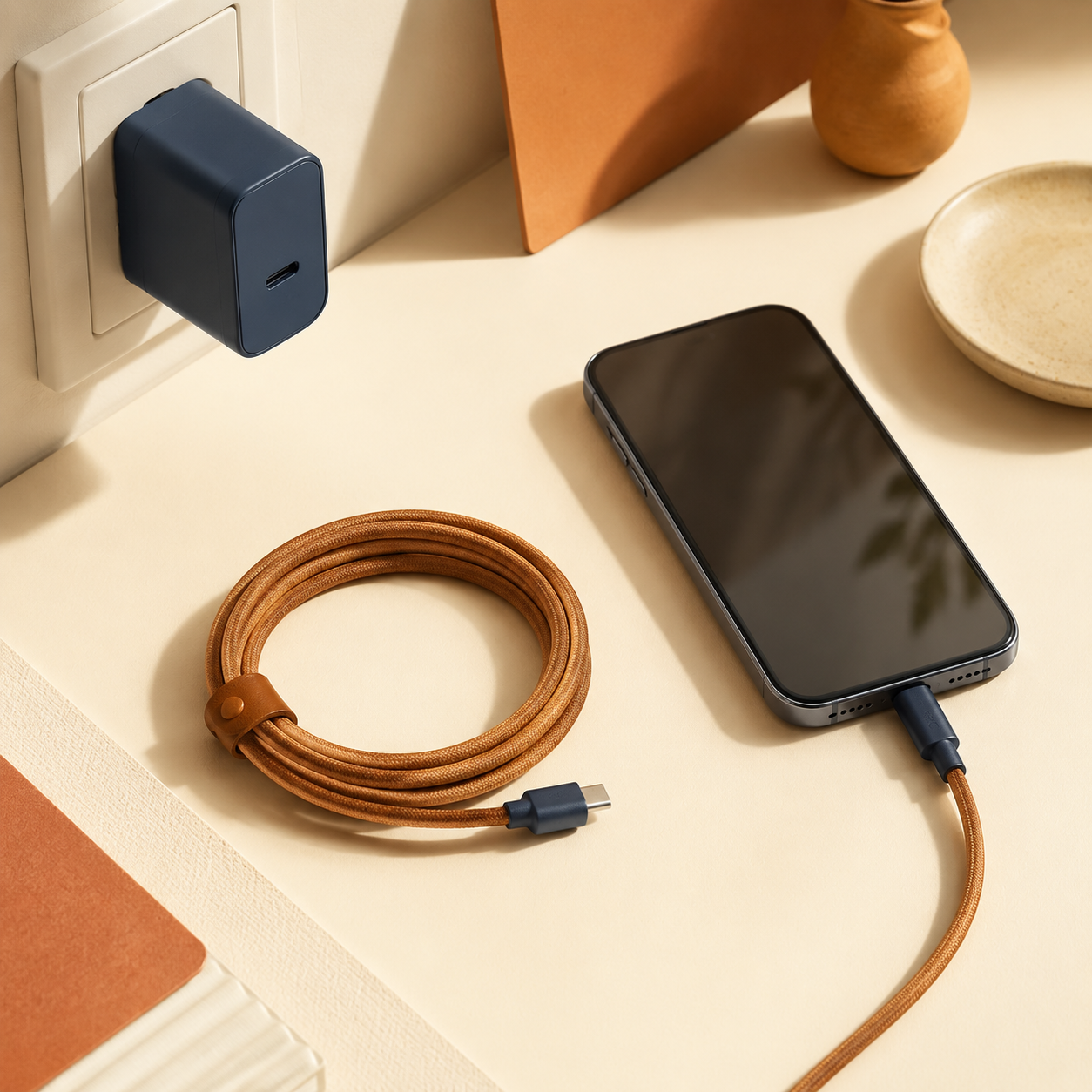
A phone charger may be labelled 20W, 30W or more, but that number is not a constant reading from the wall. It usually describes the maximum output the charger can provide, while the phone changes its demand during a charging session.
Last reviewed: August 23, 2026. Charger standards, device support and electricity prices change, so check the current product specifications and your local tariff before making a precise calculation.
A phone charger uses the most electricity while it is actively charging, but the actual power varies with the phone, battery level, cable, charger and charging protocol. A charger rated at 30W can offer up to 30W under the right conditions; it does not normally draw 30W continuously. To know the real wall-side use, measure it with a suitable power meter or calculate it from an average watt reading rather than the label alone.
Watts are a rate
Wattage tells you how quickly power is being used or supplied at a particular moment.
Charging is not constant
The phone may draw more at one point and less as the battery becomes fuller or the device gets warm.
The label is a ceiling
A 30W or 65W label usually describes available output, not the phone’s continuous demand.
Idle use is separate
A connected charger can use a small amount even when no phone is attached, but the result varies by model.
Power, energy and cost are different
The word “power” is often used to describe several different things. Keeping the terms separate makes charger claims much easier to understand.
| Term | What it tells you | Example |
|---|---|---|
| Watts (W) | The rate of power being used or delivered at a moment. | A charger can offer up to 30W of output. |
| Watt-hours (Wh) | Power used over a period of time. | 20W for two hours is 40Wh before considering losses. |
| Kilowatt-hours (kWh) | A larger energy unit used on electricity bills. | 1,000Wh equals 1kWh. |
| Cost | Energy used multiplied by your electricity rate. | 14.6kWh at $0.30/kWh would be $4.38. |
The wider explanation in What Is Energy Consumption? is useful here: the electricity cost comes from energy used over time, not simply from the largest number printed on a charger.
What does the charger’s wattage mean?
A charger label such as 20W, 30W or 65W normally tells you the maximum output the charger can provide under specified conditions. It is useful when checking whether the charger can support a device, but it is not a promise that the charger will draw that amount every minute.
The phone and charger negotiate what can be delivered. The phone may request less than the charger’s maximum because of its design, battery condition, temperature, charging mode or the cable being used. A larger charger can therefore be compatible with a smaller device without forcing the device to take the full advertised wattage, provided the products use compatible standards and are safe to use together.
That is why a 65W laptop charger does not automatically make a phone use 65W. The number describes what the charger can offer, not what every connected device must consume.
How much power does a phone really draw?
There is no single number for every phone or every minute. Charging usually changes over the session. The phone may accept more power when the battery is low, reduce the rate as the battery fills and limit input if the device becomes warm. Background activity, screen use and the phone’s own power management also affect the wall-side reading.
At the beginning
The phone may accept a higher rate if the charger, cable and device support it.
During normal charging
The phone adjusts its demand to protect the battery and manage heat.
Near full charge
The charging rate often drops as the battery approaches its target level.
After charging
The phone may draw little or no charging power while the charger still consumes its own idle amount.
Conversion losses matter too. The electricity coming from the wall is used by the charger’s power electronics as well as the phone, so wall-side input is usually a little higher than the power reaching the phone. If you want to know what your household meter sees, measure at the wall rather than relying on a phone app or the charger’s output label.
An example annual cost calculation
Suppose a charger-and-phone combination averages 20W at the wall for two hours a day. This is an illustration, not a typical value for every phone.
At an example electricity rate of $0.30 per kWh, that would be about $4.38 per year. If the phone takes less time, charges less often or averages a lower wall-side draw, the result is lower. If you charge multiple phones, tablets or power banks from the same charger, add their actual energy use rather than multiplying the charger’s maximum rating.
| Average wall-side power | Two hours per day | Annual energy | Cost at $0.30/kWh |
|---|---|---|---|
| 5W | 2 hours daily | 3.65 kWh | $1.10 |
| 10W | 2 hours daily | 7.30 kWh | $2.19 |
| 20W | 2 hours daily | 14.60 kWh | $4.38 |
| 30W | 2 hours daily | 21.90 kWh | $6.57 |
The table uses a constant average power to make the arithmetic clear. Real charging is not constant, and your electricity rate may be different. For a more complete ownership decision, combine energy use with purchase price and expected lifespan using What Is Total Cost of Ownership?.
Does a charger use power when no phone is connected?
It can. An external power supply may draw a small amount of electricity when it is plugged in but not actively charging a device. Modern chargers are designed to reduce this no-load or standby use, but the exact result depends on the charger and its design.
The U.S. Department of Energy’s standby-power measurement guidance treats a portable appliance’s charger or base station as the item to measure when the rechargeable appliance is detached. That is a useful reminder that “nothing is plugged into the USB port” does not necessarily mean “the wall-side reading is exactly zero.”
For one modern charger, the cost is usually small. The question becomes more relevant when you have many chargers, hubs and power supplies connected continuously. In that case, see Does Leaving a Charger Plugged In Use Electricity? and What Is Standby Power?.
Where do USB-C and fast charging fit?
USB-C describes the connector family, not one fixed charging speed. The charging capability depends on the charger, cable, phone and protocol they support together. A USB-C cable that fits physically may still have different power or data capabilities from another cable.
USB Power Delivery is a negotiation system that lets compatible devices request suitable power. USB-IF says the USB PD 3.1 specification expands supported power levels up to 240W over a full-featured USB Type-C cable and connector. That is a maximum capability for the specification, not a claim about what a phone will consume.
When shopping, check the device maker’s supported charging standard and the cable requirements. USB-C Explained covers the connector question, while What Does Fast Charging Actually Mean? goes deeper into charging speed and compatibility.
How to measure a phone charger’s real use
Use a plug-in energy meter that sits between the wall outlet and the charger’s plug. It measures the input that matters for your electricity bill. A USB meter can be useful for examining output to the device, but it does not tell you the full wall-side cost by itself.
What to look for when buying a charger
Energy use is only one part of a good charger decision. A charger that is efficient but unreliable, incompatible or unsafe is not a good purchase.
| Check | Why it matters | What to verify |
|---|---|---|
| Output profile | Shows whether the charger can provide the phone’s supported modes. | Look at voltage, current, USB PD or PPS support, not just the headline wattage. |
| Cable requirements | The cable can limit charging capability or create compatibility problems. | Check the cable rating and whether it is included or must be purchased separately. |
| Certification and source | Trusted sourcing reduces the risk of counterfeit or poorly made electrical equipment. | Look for credible compliance information and buy from a reputable retailer. |
| Idle behaviour | Matters when the charger will remain plugged in continuously. | Check no-load or standby information where the manufacturer provides it. |
| Total ownership cost | A cheaper charger is not a bargain if it fails early or needs a replacement cable. | Compare durability, warranty, output needs and expected years of use. |
USB-IF recommends buying compliant products from trusted sources and points consumers toward certified USB products. That does not mean every charger with a large wattage number is unsafe, but it is a reason to treat anonymous, poorly documented chargers with caution.
Safety mistakes to avoid
- Do not keep using a charger, cable or plug that is damaged, hot, buzzing or discoloured.
- Do not cover a charger while it is operating or place it under bedding and other insulating material.
- Do not assume that a USB-C connector guarantees the same charging capability on every product.
- Do not use a cable with damaged insulation or loose connectors.
- Do not judge safety by wattage alone; electrical construction, certification and protection features matter too.
- Do not leave questionable chargers connected unattended simply because the phone is not attached.
A charger is a small electrical product, but it still converts mains electricity. The goal is not to avoid every fraction of standby use. It is to use a suitable, compliant charger, understand the real charging demand and replace equipment that is no longer safe.
The bottom line
A phone charger does not normally use its printed wattage all the time. The label describes the output it can offer, while the phone chooses how much power to request and changes that demand throughout the charging session. Wall-side energy also includes the charger’s own conversion losses and any idle consumption.
For a realistic answer, measure the charger at the wall or calculate from an average watt reading and your actual charging routine. The annual cost for one phone is often modest, but compatibility, reliability and electrical safety matter more than chasing the lowest possible number.
Use the charger label to check capability, not to estimate constant electricity use. Use a wall-side measurement to understand real consumption, and choose a safe, compatible charger from a reputable source.
Frequently asked questions
How many watts does a phone charger use?
It depends on the phone, charger, cable and charging stage. A charger labelled 30W can offer up to 30W, but the phone may draw less and may reduce its demand as the battery becomes fuller.
Does a 30W charger always use 30W?
No. Thirty watts is usually the charger’s maximum available output under the right conditions. It is not a constant wall-side reading.
Does a phone charger use electricity when it is plugged in?
It can use a small amount even when no phone is attached. The exact no-load result varies by charger, so measure it if the question matters to you.
Is a higher-watt charger more expensive to run?
Not automatically. A higher-rated charger does not force a phone to draw its maximum output. Actual cost depends on the phone’s demand, charging time and the charger’s efficiency.
How much does it cost to charge a phone?
Use average wall-side watts × charging hours ÷ 1,000 to estimate kWh, then multiply by your electricity rate. A meter gives a better result than the charger’s maximum rating.
Does fast charging use more electricity?
Fast charging can deliver power more quickly, but total energy depends on the battery, charging losses, usage and how often the phone is charged. Faster maximum power does not by itself determine annual cost.
Is USB-C the same as fast charging?
No. USB-C is a connector family. Charging speed depends on the charger, cable, phone and supported charging protocol.
How can I measure my charger’s electricity use?
Use a suitable plug-in power meter between the wall outlet and the charger. Measure both the idle charger and a normal charging session, then convert the accumulated energy into cost.